
| Share/Comment | |||
 |
Tweet |  |
|
 |
Feedback |  |
|
Benchmarking is a standard by which something can be measured or judged. This term was first used by surveyors. They set a benchmark by marking a point of known vertical elevation. Therefore benchmark becomes a point of reference for a measurement.
We benchmark everyday. We compare our performance, lifestyle, or a game of golf with friends and peers.
What is benchmarking in a business environment? It involves making comparisons with other businesses, so that we can develop an objective assessment of our business. It helps us to a) identify areas for breakthrough improvements, b) establish higher targets, and c) new priorities.
Note benchmarking is not simple comparison and subsequent blind copy of what seems to be the best. We must carefully analyze the outcome of benchmarking and focus on what adds maximum value in our business context. There are three types of benchmarking.
Internal Benchmarking
It compares (critical-to-business) processes or products across the organization on key critical-to-quality parameters such as turn-around-time or cost.
Functional Benchmarking
It compares similar functions or processes with industry leaders in that area.
Competitive Benchmarking
It focuses on direct competitors in terms of their products, services, processes, and customers.
The following flowchart summarizes the benchmarking processes.
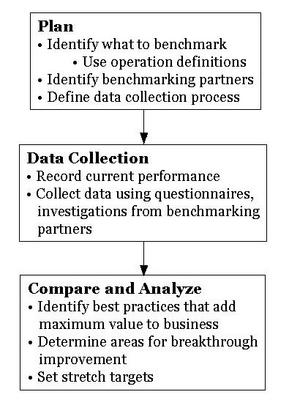
Some of the simple and common candidates for benchmarking are customer satisfaction, critical-to-business processes, products, profitability, and value addition per employee. The list is endless. We need to shortlist what is critical to our business success.
comments powered by Disqus
Commenting Guidelines
We hope the conversations that take place on “discover6sigma.org” will be constructive in context of the topic. To ensure the quality of the discussion stays in check, our moderators will review all the comments and may edit them for clarity and relevance.
The comments that are posted using fowl language, promotional phrases and are not relevant in the said context, may be deleted as per moderators discretion.
By posting a comment here, you agree to give “discover6sigma.org” the rights to use the contents of your comments anywhere.